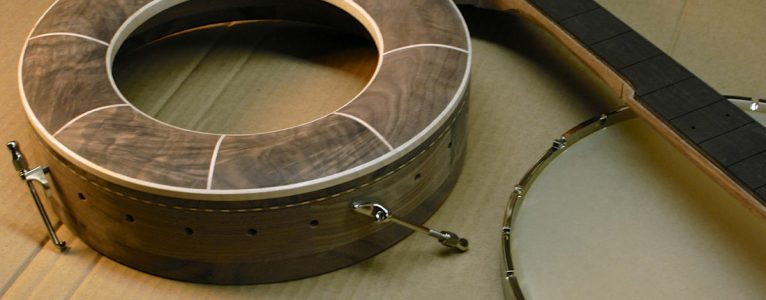

Several years ago, Amber heard John Hartford playing a banjo that sounded as incredible as his playing. It was mellow without being tubby, and had tons of tone. She did some research and found that the banjo was a modern instrument that featured a wooden tone ring. (The tone ring on a banjo is the part the head rests upon; usually it’s made of metal, and can be very simple, like a rolled brass hoop, or quite an intricate profile, like the famous Whyte Ladie)
The idea of a wood tone ring intrigued both of us.

Fast forward a few years, and I’ve been asked several times if I would build new, 5-string necks for vintage tenor banjo pots. I’ve never said yes, because I wasn’t set up to do it (and because it hurts me to de-tenorize nice old tenor banjos).
After listening to a bevy of banjos (and her critiques on each) while Amber was shopping for a new one, I reconsidered. After all, I am almost set up to make banjo necks. To practice, I thought I’d build a banjo from scratch and see how the wooden tone ring sounds. I discovered a banjo builder and pot turner who is interested in wooden tone rings: Mark Hickler. I ordered a walnut rim with an internal resonator and an East Indian rosewood tone ring.
I’ve dressed up the pot a little and rough-carved the walnut neck. So what’s left to do is shape the headstock and add a bunch of inlay.
Then add a little more inlay.
(This is a banjo, after all.)
This is quite awesome. I shall not judge!